Showing posts with label storytime. Show all posts

Sunday, July 27, 2014

Robot Family Storytime

Robots: A Family Storytime - All ages, Wednesday, July 9, 2014, 3:30 p.m.,  Attendance: 35


Books: Boy + Bot by Arne Dyckman
            Birthday Box by Leslie Patricelli
            The Bad Birthday Idea by Madeline Valentine

Draw and Tell Story: "Building a Bot"

Board Story: "Springy Arms to the Rescue!"

Songs:  "The Robot" (tune: "The Wheels on the Bus") from 1001 Rhymes and Fingerplays
              "Five Noisy Robots" (tune: "5 Green and Speckled Frogs")
The song lyrics were found in "Here Come the Robots" a storytime plan from the Omaha Public Library. Of course there is no URL on the pages I printed out and I cannot find it again.

Magic Envelope: Robot (for information about the magic envelope see this post by Sharon of Rain Makes Applesauce.)

Craft: Robot Masks Various robot masks can be found online. Each mask was printed on card stock  and then cut out. A large craft stick was taped in the back so each child could hold it up in front of his/her face.

Notes: I did not do this storytime due to an injury. My colleague,who substituted, informed me that the draw and tell story, board story and the magic envelope were very successful. It took a while but a 5-year-old did guess what was being drawn upside down. Even the older kids were impressed by the magic envelope.

Friday, May 30, 2014

Springy Arms to the Rescue!

One of my family storytime programs this summer will be about robots. There are plenty of books about robots but I try to have a variety of stories to keep the interest of this multi-age group. The following is the story I came up with to tell using our magnet board. It will work well with a felt/flannel board too.

Springy Arms to the Rescue!
by Linda Meuse
Notes from the Story Room 

LR1 was a bored little bot. The big robots were always busy running back and forth all day long. Not one had time for him. He wanted to help but no one would stop to tell him what to do.

One day LR1 had an idea. He noticed that the big robots had to slow down to get around him, but he was the only little bot so they quickly sped up again. He thought, "If there were lots of little bots then the big robots would have to slow down even more. Then I could talk to them." LR1 needed to get into the "Robot Production Room" so he could make more little bots. He looked around and saw three doors. One door had the letters RRR on it. That must be the "Robot Repair Room." That was where the robots who broke down went to get fixed. The second door had the letters RLR on it. That was the "Robot Lubrication Room." Once a week each robot went in there to get a bath of fresh oil to keep all parts running smoothly. The third door had the letters RPR on it. "Yes!" said LR1, "That's the "Robot Production Room." Now since LR1 was a very small bot, the door handle was out of reach. For a second LR1 was worried but then he remembered, "I have springy arms. Springy arms to the rescue!" His arm uncurled and easily reached the door handle. He quickly opened the door and slipped into the "Robot Production Room," closing the door behind him. The big robots were too busy to notice. LR1 went to the control panel and punched in all the information needed to make little bots. He made sure that they all had springy arms. Then he pressed the start button. The conveyor belt began to roll. Pieces were assembled. It did not take long to make more little bots. "Now we can slow down the big bots," said LR1. "Follow me!" The little bots followed LR1 into the other room. Almost immediately the big robots started slowing down. They didn't want to trip over the little bots. If they did, they would end up in the "Robot Repair Room." "Where did all these little bots come from?" asked BR1. "We're here to help!" said LR1. "What do you want us to do?" BR1 thought for a moment and said, "It's difficult for us to bend down. Perhaps you can pick things up for us. You can use your springy arms to reach under things for us too." "Great!" said LR1. "Springy arms to the rescue!"

Each little bot was paired with a big robot. LR1 was no longer bored. Not only did he have a job to do but he also now had lots of little robot friends.

LR1 and BR1
 
Doors and Control Panel
 
LR1's arm uncoiled


Notes: Since my library has a magnet board, I made my robots out of card stock and colored them with marker. Each "springy" arm is made by cutting a spiral. Then glue the outer end to the back of the robot. Since I am using paper, it will be easy for me to make more robots. I will run a master through the copy machine. I will probably make 10 of each. Five would be fine if you don't want to make that many. The children will get the point. I drew my own robots which is easy to do but you can also use clip art which is also easy to reproduce. The robots can also be made of felt. Some of you may already have ones you can use if you've done the "Five Little Robots" rhyme. I would still make the arms from paper since it coils and uncoils so well. My additional figures will all have numbers. For the little robots it will be LR2, LR3, LR4 etc. and for the big robots it will be BR2, BR3, BR4 etc. LR stands for Little Robot and BR stands for Big Robot. Numbering the robots is optional.

I am hosting this week's (small) Flannel Friday round-up. Click here for the direct link.


Wednesday, May 21, 2014

Makers by Example

Currently there is much discussion in the library world about libraries as maker spaces. Though 3-D printers and electronics are often cited as part of the maker movement, it also includes crafts. Libraries are including sewing machines and button makers in their maker spaces. The focus is on giving library users the resources to create.

Youth services librarians have always encouraged creativity. Sometimes it is as simple as a storytime craft or having blocks available. Craft programs for older children are staples of youth services programming.

When the maker movement spread to libraries, youth services librarians were quick to point out that they were already offering such opportunities. What is not as obvious, is the fact that much of what we do to present an engaging storytime also involves making. Felt board figures, finger puppets and props are often made by the storytelling staff. Special activities are created to promote early literacy skills. Some are part of storytime and some are part of free play in the children's area.

Much thought has gone into these activities and their relation to early literacy skills. Parents are given early literacy tips during storytime. In addition we should point out that what we make for storytime can be simplified and duplicated at home. Many librarians do point this out to parents but I'm not sure it is done on a regular basis. We are not just providing information but are showing parents how it can be applied.

When I first started doing preschool storytime, I often would hand out a paper with a storytime rhyme and easy to make finger puppets on it. One of my favorite storytime crafts is to make paper bag puppets or stick puppets so that the children can reenact the stories they had just heard (or make up completely new ones). Again we are showing parents a simple way to develop narrative skills.

Children's librarians are creative folk. We are makers in many ways. Just look at Flannel Friday's Pinterest boards for examples. We are used to sharing our ideas with other librarians but don't forget to share those great ideas with parents as well!

Basic Librarian Maker Tools

Friday, February 21, 2014

Felt Board Figures with Interfacing

There are some beautiful felt pieces being made by Flannel Friday participants. I particularly love the style of those made by Jane of Piper Loves the Library.  (I would like to make pieces like that some day.) It is definitely worth it to make some high quality felt sets. Figures in felt have depth and dimension. When this is not practical, there are other options.

Although I used a felt board for fifteen years, I must confess that I never made a figure out of felt. Instead, I made them out of heavyweight interfacing. (When I used a flannel board, I was a department of one and did not have the time or patience to make felt pieces. My current library uses a magnet board so pieces are colored with marker and laminated.) Another option is to use milk filters. I have never used them but you can find out more about them from Anne's post. Andrea shows some chickadees she made using milk filters on her blog.

The interfacing method has advantages and disadvantages. Interfacing is easy to cut and all you need is a set of markers to provide a variety of colors. However it is not as thick as felt so you need a backing if you want to hide something behind a figure. Without a backing the other piece will show through. The biggest disadvantage is that it does not stick to itself like felt so you cannot put pieces on top of each other. (I would use a glue stick to add a small amount of glue when I needed to make pieces stick to each other.) What I like best about using interfacing is that it is easy to make pieces with details. Patterns show through even the heavyweight interfacing. Once you get the hang of it, you can make pieces quickly so I recommend this method if you are pressed for time.

Tips:

Choose the correct kind of interfacing. Use heavyweight non-fusible or sew-in interfacing if it is available. If not, medium weight will work. Do not get fusible interfacing. It has glue on the back so it will not stick. Should you end up with some, draw on the shiny (glue) side so the piece will stick to the felt board. Lightweight interfacing is flimsy and does not stick to the felt board well. One yard of interfacing will produce numerous felt board figures.

One yard of medium weight interfacing with a felt piece and bonus cat (Pete's sister Ducky)
 
Photocopy your pattern if possible. I usually make a working copy to protect my original.
 
Interfacing over pattern - ready to be traced
 
Place the pattern under the interfacing for tracing. I usually cut out a piece slightly larger than the pattern piece. It is easier to work with that small piece then a large piece of fabric. If you are doing a set of figures, you can also trace them all on a larger piece and then cut each one to outline and color. I would do this to fit the figures close to each other so I would not waste fabric.
 
Trace the pattern. I trace with a pencil first and then I go over the pencil lines with a black marker. You can trace using a marker but definitely use a copy of your pattern for marker can bleed through.
 
Pattern is traced

Color your piece. I find that markers work best. Color in small spaces with black marker. This makes the piece sturdier and easier to cut out.

Optional: Outline your piece with black marker. I like the look of outlined pieces.
  
Piece is colored and outlined
 
Fill in small spaces
 
Cut out your piece.

Piece is cut out
 
Ducky shows how the pieces for Mole's New Hole look on a felt board
 
Storage tips: Place plain paper between pieces to keep the colors from bleeding onto other pieces. To be honest I seldom did this and it only happened a couple of times. Freshly colored pieces will bleed so make sure the pieces are completely dry before putting pieces with each other. I stored the pieces for each set in a manila envelope along with a copy of the story. Note on the envelope the number of pieces. I also keep a record of when and where I used the story on the front of the envelope.

These pieces will last a long time. I still have the first set I made using my own drawings for The Princess and the Pea which I made close to 20 years ago.

This week's Flannel Friday Round-Up is hosted by K Leigh of Storytime ABC'S.

Sunday, November 3, 2013

Halloween Preschool Storytime

October 31, 2013, 10:00 a.m., Attendance - 14 lively preschoolers

Books: What's in the Witch's Kitchen? by Nick Sharret
            The Spooky Box by Mark Gonyer
            Silly Skeletons by Janet Lawler

Board Stories: "Snacks for Ghosts"
                        "The Little Old Lady Who Was Not Afraid of Anything"
                                   
Rhyme: "Flap, Flap, Flap Go the Wings of the Bat..." by Katie Ahearn Fitzgerald

Rhyme with Prop: "Five Little Ghosts"

Magic Envelope: In went parts, out came a Jack O'Lantern

Game: Find the Bat Under the Witch's Hat

Craft: Paper plate Jack O'Lantern (Craft from Oriental Trading)

Notes: This group was ready to celebrate! Most came in costume. We played a trick on them for I switched with the librarian who usually does the preschool storytime. We started with a cryer (evidently this was not unusual for him) which caused me to change my plan a bit. I had wanted to start with a book but instead started with "Snacks for Ghosts" which caught every one's attention. From then on we had a great time and could have gone well beyond our thirty minutes.


Thursday, May 16, 2013

Telling One Story Five Ways - Conclusion

This is the last of a series of posts about "Telling One Story Five Ways."

"The Fisherman and His Wife" has been presented five ways - as a board story, using stick puppets, using props, as a draw and tell story and as a cut and tell story. Once I wrote my version of the story, I only needed to make minor changes to fit each of the different formats. Although I enjoyed the creative challenge of telling one story five ways, the reason I did so was to show that stories can be easily adapted to various formats and to encourage storytellers to try something different. If something does not work one way, I change it to something that does work. By doing so I am no longer limited to what is available when I plan my programs. I make changes all the time. I change stories so that I am comfortable telling them. I change stories to increase their appeal to my audience. This viewpoint has actually made my programs more creative and I've had positive feedback from my audience. It has certainly made planning my family storytimes much easier! Presenting the program is also more fun especially when I come up with something as over the top as "Sam and the Acorn."

Of course there are more than five ways to tell a story. I chose these five because they are the formats I use the most. Sometimes I mix formats. I use props and stick puppets when telling "The Birds and the Trees" and I use board figures and props when telling "The Most Wonderful Egg in the World."  "The Fisherman and His Wife" could also be performed by storytellers such as those done by Beyond the Book Storytimes or it could be adapted for Readers' Theater with students performing.

Now I must say farewell to the humble fisherman and his overachieving wife. I hope that their "stories" have inspired you. Now I must start thinking about my summer family storytimes. My library is doing the CSLP program, "Dig Into Reading." So far I have only a couple of stories, "Mole's New Hole" and a vegan version of "Herman the Worm."

Wednesday, May 8, 2013

The Fisherman and His Wife - Cut and Tell Story

This is part of a series of posts about Telling One Story Five Ways. It is also my Flannel Friday contribution for this week.

A cut and tell story will capture an audience's attention. Children want to see what you are cutting out and often try to guess. It is also great to take "on the road" since a piece of paper and a pair of scissors is all you need. All the preparation is done ahead of time. The storyteller just has to be careful that the audience does not see that part or the "magic" will be spoiled.

This cut and tell version of The Fisherman and His Wife is fairly easy to do. Years ago I told a more complicated version. I think it can be found in Paper Stories by Jean Stangl. I told it probably 15 years ago and I no longer have access to the book so I'm hoping I have the correct title. In this version, the storyteller is cutting out a crown. Use gold or yellow 8.5" x 11" paper. It can be easily crumpled at the end of the story. Fold the paper in half from top to bottom. Place the left side of the pattern along the fold and trace the pattern onto the paper with a pencil.

The Fisherman and His Wife - A Cut and Tell Story
by Linda Meuse
Notes from the Story Room

Long ago there was a fisherman who lived with his wife in a tiny shack by the sea. They had nothing but tfisherman was content.

One day the fisherman caught a most unusual fish. (Cut out A - the fish) The fish could talk! It asked the fisherman to set him free. The fisherman set him free and went home to tell his wife about his strange experience. "You should have made the fish grant you a wish since you spared his life," said the wife. "Go back and tell him that I want to live in a nice house." The fisherman went back to the sea. (Cut from 1 to 2) He called, "Oh wondrous fish, my wife has a wish." The fish rose out of the waves (Show fish) and asked, "What does she want?" "My wife wants to live in a nice house," answered the fisherman. "Her wish is granted," said the fish diving back into the sea. The fisherman returned home (Cut from 2 to 3) to find a nice house where the shack had been.

Alas, the wife was not content. She wanted more. "Go to the fish and tell him I want to live in a fine mansion," said the wife. The fisherman returned to the sea (Cut from 3 to 4) and called the fish. "Oh wondrous fish, my wife has a wish," said the fisherman. Again the fish rose above the waves (Show fish) and asked, "What does she want?" The fisherman answered, "My wife wants to live in a fine mansion." "Her wish is granted," replied the fish as he went back into the sea. The fisherman returned home (Cut from 4 to 5) to find a fine mansion where the house had been.

Still the wife was not content. She told her husband, "Go tell the fish that I want to become king and live in a castle." Again the fisherman went to the sea (Cut from 5 to 6) and called to the fish, "Oh wondrous fish, my wife has a wish." Again the fish appeared (Show fish) and asked, "What does she want?" "She wants to be king and live in a castle," said the fisherman. "Her wish is granted," said the fish as he leaped back into the sea. The fisherman returned home (Cut from 6 to 7) to find a castle where the mansion had been. (Cut B removing excess) His wife was wearing a crown. (Show B holding ends together to make a small crown)

Yet the wife was not content. "This crown is too small and too plain. I want one with a large gem in the middle. Also, I want to be emperor and live in a magnificent palace. Go back and tell the fish." The fisherman returned to the sea (Cut from 7 to 8) and called, "Oh wondrous fish, my wife has a wish." The fish appeared (Show fish) and asked, "What does she want?" The fisherman replied, "She wants a bigger crown with a gem in the middle. She wants to be emperor and live in a magnificent palace." "Her wish is granted," said the fish going back into the sea. The fisherman returned home (Cut from 8 to 9) to find a magnificent palace where the castle had been. His wife was wearing an even bigger crown. (Open paper to show the crown)

Even with all that the wife was not content. "I want to rule all of the stars and all of the planets. I want to rule the universe! Go tell the fish," said the wife. Sadly the fisherman returned to the sea and called, "Oh wondrous fish, my wife has a wish." The fish came up out the sea (Show fish) and asked, "What does she want?" The fisherman answered, "She wants to be ruler of the universe." "That she cannot do," said the fish. "She has asked for too much. She will have to be content with nothing." The fish dove back into the sea never to be seen again. The fisherman returned home to find the shack back where the palace had been. Indeed the fisherman and his wife were back where they had started - with nothing. (Crumple crown and toss)
 

Pattern


I outline my pattern in black marker. I then place it under the paper I am using. The maker shows through the paper making it easy to trace the pattern. The photo below shows this. If I were using heavier paper, I would cut out the pattern, place it on the paper and trace around it.


Below are the final pieces. I taped the small crown to show how I would hold it to show the audience.


This week's Flannel Friday Round-Up is hosted by Amanda of the Trails & Tales blog.


Thursday, May 2, 2013

The Fisherman and His Wife - Draw and Tell Story

This is a part of a series of posts about "Telling One Story Five Ways." It is also my Flannel Friday contribution for this week.

This tale is fairly long for a draw and tell story. It can be done, though the resulting story is one for an experienced draw and tell storyteller. The reason I made it into a draw and tell story is to show how a single story can be adapted to various formats.

This story takes a bit of preparation. It has to be drawn on paper which will be folded in half lengthwise at the end of the story. Since markers bleed through most paper a second sheet of paper should be glued to the bottom half on the back. I took a second piece of paper, folded it in half and glued the halves together, and then I glued that to the back of the first piece of paper. I then folded the paper in half to create a fold line to use as a guide for the placement of the figures and buildings.

To help show how the drawing comes together, I used different colored markers in the examples below. When actually doing the drawing a single color is all that is needed. However, I liked how the final drawing turned out. I am definitely tempted try telling the story using the different colors. It would be a challenge.

It is also going to take a bit of time drawing the buildings as they get more elaborate. I would talk about the how each one differs from the previous one as I draw them.

The Fisherman and His Wife: A Draw and Tell Story
 Linda Meuse
Notes from the Story Room

Long ago there a fisherman (1) and his wife (2) who lived in a very small shack (3) by the sea. One day the fisherman went down to the sea to fish as usual. He quickly felt a tug on his line and pulled up the largest and most unusual fish he had ever seen (4). He was quite startled when the fish begged for his freedom. The fisherman released the  fish back into the sea.


When the fisherman returned home, he told his wife about his strange experience with a talking fish. "You should have made him grant you a wish!" she said. "You spared his life and he owes you a wish. Go back and ask him for a nice house for I am tired of living in a tiny shack." The fisherman went back to the sea (5) and called, "Oh wondrous fish, my wife has a wish" "What does she want?" asked the fish as it came up above the waves. "She wants a nice house to live in," replied the fisherman. "Her wish is granted," said the fish disappearing under the waves. The fisherman returned home to find a nice house (6) where the shack had been.


A week passed but the wife was not happy. "This house is not big enough," said the wife. "Go back and tell the fish we need a fine mansion." The fisherman returned to the sea (7). "Oh wondrous fish, my wife has a wish," called the fisherman. The fish appeared and asked, "What does she want?" "She wants a fine mansion," said the fisherman. "Her wish is granted," said the fish diving back into the sea. The fisherman returned home to find a fine mansion where the house had been (8).


A week passed but the wife was still not happy. She said, "Go back to the sea and tell the fish that I want to live in a castle. Since I will have a castle I should be king as well." The fisherman went back to the sea (9). He called to the fish, "Oh wondrous fish, my wife has a wish." Again the fish appeared and asked, "What does she want?" The fisherman answered, "She wants to live in a castle and be king." "Her wish is granted," said the fish. The fisherman returned to find a castle (10) where the mansion had been. His wife was wearing a crown (11).


Another week passed. The wife was still not happy so she said to her husband, "Go back to the fish and tell him I want to be emperor and live in a magnificent palace." The fisherman returned to the sea (12) and called, "Oh wondrous fish, my wife has a wish." "What does she want now?" asked the fish. The fisherman replied, "She wants to be emperor and live in a magnificent palace." "Her wish is granted," said the fish. The fisherman returned to find a magnificent palace (13) where the castle had been. His wife was wearing an even bigger crown (14).


Was the wife finally happy? No. A week later the wife said to her husband, "Tell the fish that I want to rule the universe and everything in it including the moon and the stars." Sadly the fisherman returned to the sea (15). The fisherman called, "Oh wondrous fish, my wife has a wish." "What does she want?" asked the fish. "She wants to rule the universe and everything in it," answered the fisherman. "That she cannot do," replied the fish. "Now she must live with what she deserves." The fish dove into the sea never to be seen again and the fisherman returned home to find their tiny shack where the magnifcent palace had been (16).


Drawing Sequence:
(1) Draw fisherman with fishing pole near the bottom of the paper
(2) Draw wife below the fold line leaving enough room to draw the crowns on her head later in the story
(3) Draw the shack in the center with the bottom on the fold line
(4) Draw the fish
(5) Draw waves
(6) Draw house using the shack as a door
(7) Draw waves
(8) Draw mansion around house
(9) Draw waves
(10) Draw castle around mansion
(11) Draw crown
(12) Draw waves
(13) Draw palace around castle
(14) Draw larger crown
(15) Draw waves
(16) Fold bottom half up and draw the shack again

The front - with drawing sequence numbers:


The back:


This week's Flannel Friday Round-Up is being hosted by Library Quine of the Loons and Quines blog.


Friday, April 26, 2013

The Fisherman and His Wife - With Props

This post is part of a series of posts about "Telling One Story Five Ways." It is also my Flannel Friday contribution for this week.

Next up - using props to tell the story of "The Fisherman and His Wife." I love using props in storytime. Not only do props appeal to the audience but they help me as a storyteller, working much like the board figures do by providing clues to what comes next in the story. Props can be very simple or quite elaborate. They can be found objects or silly hats. Almost anything can be used as a prop as long as it fits the story. See the "Prop Stories" page for some of the props I have made.

I have chosen two types of props for "The Fisherman and His Wife." One is quick and easy. The other uses the figures I have already made but takes them off of the board and puts them on a "stage."

One of the easiest to make are what I think of as storytelling cards. Basically I paste clip art or a figure I have drawn to card stock. I simply hold up the appropriate images as I am telling the story. If you need to, you can put information on the back of the cards. I often do this when I use a rhyme or poem in storytime. (For an example see my "Shell Silverstein's 'Snowball' post. This is also a great way to take a story "on the road" without having to bring a felt board. The story that goes with these props can be found in "The Fisherman and His Wife - Board Story" post.


I also like using stand-up figures. It's fun to move them around on a "stage." I usually use a table if the the figures are large or an upturned box if the figures are small. (For an example of larger figures see my post "Aliens at Bedtime"). It is not necessary to make the buildings. The figures and story from my "The Fisherman and His Wife - Stick Puppets" post does not require buildings. I used Velcro to hold the crowns on the fisherman's wife. I colored over the Velcro with marker so it will be less noticeable. I taped rolls of paper to the back of each figure for a stand.


The photo above shows all the figures on a table. For storytelling I would use a large box turned upside down as a "stage." I actually have a box large enough for the palace figure. I use it to store my storytelling props. The box in the photos below is another one I use as a "stage." It stores my craft samples.


This week's Flannel Friday Round-Up is hosted by Andrea of the RovingFiddlehead Kidlit blog.

Friday, April 12, 2013

The Fisherman and His Wife - Stick Puppets

This post is part of a series of posts about "Telling One Story Five Ways." It is also my Flannel Friday contribution for this week.

The second way to tell this story is to use stick puppets. Stick puppets bring the figures off the flannel/magnet board and enable the storyteller to add some action. For example, when the fisherman is in his boat, you can move him up and down to show the motion of the waves. Since I tell rather than read most of the stories in my family story time, using stick puppets for a story adds variety to the program. Since they are so light and take up little space, stick puppets are also easy to bring along for school visits. Other example of using stick puppets can be found on the "Puppet Stories" page.

Stick puppets are quick and easy to make. In this case I am using the same figures I used for the board story. I colored them and glued them to heavier paper. I use card stock or construction paper. I usually leave a border when I cut them out but in this case I did not because I want to be able to put the crowns on the fisherman's wife. I taped a craft stick on the back of each figure. Instead of using glitter glue as I did for the board figures, I used metallic paper and sequins to add some "sparkle" to the fish and crowns. If desired you could make a fishing rod and a boat as well as add waves under the fish.


The Fisherman and His Wife
Linda Meuse
Notes from the Story Room

Note: This is the same story as the one for the flannel/magnet board with some minor changes. Since I won't be using the buildings in this version of the story, I have added Velcro to the fisherman's wife so she can hold the flowers which will represent the nice house and the plate of food which will represent the mansion. The crowns will represent the castle and palace. I have changed the story slightly to reflect this.

Long ago there was a poor fisherman who lived with his wife in a tiny little shack by the sea. Even though he went fishing every day, the fisherman never caught many fish. Sometimes he caught one or two and sometimes none at all.

One day the fisherman went down to the sea to fish as usual. The waves were high as he went out in his little boat. The fisherman feared he would catch nothing that day but much to his surprise there was a tug on his line as soon as he put it in the water. The fisherman pulled up a huge fish. It was like none he had ever seen before. Just as the fisherman was about to pull it into his boat, the fish spoke. "Please spare my life!" said the fish. "I will grant you a wish if you do." The surprised fisherman let the fish go. "I could not harm a fish that can talk," he said as he watched the fish swim away.

The fisherman returned home and told his wife about his strange experience. "What did you wish for?" she immediately asked. "I forgot all about the wish because I was so surprised," he replied. "Go back right now and ask for a nice house. I'm tired of living is this run-down shack. I want to live in a nice house with a garden full of flowers. You spared his life so he has to do what you ask." Reluctantly the fisherman went to the edge of the sea and called, "Oh wondrous fish, my wife has a wish." The fish quickly appeared. "What does she want?" asked the fish. "She wants to live in a nice house with a flower garden," answered the fisherman. "Her wish is granted," said the fish as it disappeared back into the sea. When the fisherman returned home there was a lovely house where the shack had been. His wife was standing in front of it holding a bouquet of flowers from a beautiful garden.

Is that the end of the story? No. A week later the wife said to the fisherman, "This house is not big enough. Go back to the fish and ask for a fine mansion with servants. I want to have fine parties and serve lavish dinners to my guests." The fisherman went back to the edge of the sea and called, "Oh wondrous fish, my wife has a wish." "What does she want?" asked the fish popping up above the waves. "She wants a bigger house. She wants a mansion with servants," answered the fisherman. "Her wish is granted," said the fish as it went back into the sea. When the fisherman returned home he found a fine mansion where the house had been. His wife was standing in front of it holding a plate piled high with food.

Is that the end of the story? No. A week later the wife decided that the mansion was not enough. She said, "We should be living in a castle and I should be Queen and you the King." "I don't want to be King!" replied the fisherman. "Fine," said the wife, "I will be King instead." She made the fisherman go back to the edge of the sea to call the fish. "Oh wondrous fish, my wife has a wish," called the fisherman. "What does she want now?" asked the fish coming up from the water. The fisherman answered, "She wants to live in a castle and be King of this land." "Her wish is granted," said the fish as it dove back into the sea. When fisherman returned home he found a castle where the mansion had been. Inside his wife sat on a throne wearing a crown.

Is that the end of the story? No. A week later the wife decided that being King of the land was not enough. She wanted to be Emperor of the world and live in a huge palace. Again she made her poor husband go back to the edge of the sea to call the fish. "Oh wondrous fish, my wife has a wish," called the fisherman. Again the fish rose out of the sea. "What does she want?" asked the fish. "She wants to be Emperor of the world and live in a huge palace," said the fisherman. "Her wish is granted," said the fish. The fisherman returned home to find a huge palace where the castle had been. It took him an entire day to find his wife in the huge palace. She was sitting on an even bigger throne wearing an even bigger crown than before.

Is that the end of the story? No. A week later the fisherman found his wife staring up at the sky. She turned to him and said, "Go back to the fish and tell him that I want to be Ruler of the entire universe and have an even bigger palace up on the moon." Sadly the fisherman went to the edge of the sea calling, "Oh wondrous fish, my wife has a wish." "What does she want this time?" asked the fish coming up out of the sea. "She wants to be Ruler of the universe and have an even bigger palace on the moon," replied the fisherman. "I cannot grant that wish. No one can rule the stars and the moon. She must return to the home that she deserves," said the fish as it dove into the sea. The fisherman returned home to find that the huge palace was gone and their miserable shack was back. There the fisherman and his wife lived for the rest of their lives. The wondrous fish was never seen again.

Is that the end of the story? Yes!

This week's Flannel Friday Round-Up is hosted by Kendra of Read Sing Play.

Thursday, April 4, 2013

Selecting the Story

This one of a series of posts about "Telling One Story Five Ways."

Folktales are a staple of my storytime programs. They appeal to all ages and have themes that are common across cultures. Many are downright silly, humorous, or about animals - all storytime favorites.

For this storytelling project I have chosen "The Fisherman and His Wife" from Household Tales, collected by the Brothers Grimm. It is a well-known but not overly familiar story. It has the element of repetition which will appeal to younger children. This makes it a good choice for family storytime. It would also be suitable for preschool storytime and class visits.

There are several versions of "The Fisherman and His Wife" in my library's 398.2 section. It's fun to compare them to an original version such as the one found here (though even the translations from the German vary). Most picture book versions of folktales are too long for storytime which is why I write my own. For this project I am writing my own version and using my own artwork (primarily to avoid copyright issues).

Two versions that I found interesting are pictured below:

The Fisherman and His Wife by Rosemary Wells. (Dial, 1998) It is not illustrated by Wells which surprised me. The story is set in Norway and all the characters are cats. The illustrator, Eleanor Hubbard, studied art in Norway and shows all the characters in traditional dress. The ending is quite different from the original tale.

The Fisherman and the Turtle by Eric Kimmel. (Marshall Cavendish Children, 2008) Not only did Kimmel change the fish to a turtle but set the story in the land of the Aztecs. This works surprisingly well particularly the ending.

Tuesday, April 2, 2013

Telling One Story Five Ways

Over the years I have learned different ways of presenting a story. In addition to flannel or magnet board stories, I do draw and tell stories and paper cutting stories and I use stick puppets and props to tell stories. I have also ventured into storytelling using paper folding and tangrams though I have found that I am not very good at using those formats.

Why do I use so many different storytelling formats? The main reason is to engage my audience. I primarily do a family storytime for all ages and it helps to keep their attention when they don't know what will be coming next. I also want the adults who attend a storytime to enjoy it as well, whether they are parents, caregivers or teachers, for they are the ones who bring the children to the library. Another reason is simply that I have fun doing these different types of stories.

Very seldom do I tell a story exactly as written. Often there are elements that I don't like, or the story is too long or not long enough. I will change the story to suit my style of storytelling. Sometimes this happens without my realizing it. I once had a library school student who had to do a preschool storytime which was observed by her professor. I gave her the material covering the theme I was using for that week and told her to choose how she wanted to present it. One thing she did was one of my favorite flannel board stories. I had given her a copy of the original story but when she told it, it was not at all like the story I told. After the program, I looked at the original copy and it was exactly what she had told. It turns out that I had changed the story as I told it over the years! (I liked my version better.)

There are times when it has been difficult to find exactly what I want for a storytime program. This has been particularly true for my family storytime so I ended up writing my own stories. I usually adapt folktales though I have also written stories around a familiar concept such as "be careful what you wish for." I wish I had started doing this earlier because I found out that I quite enjoy doing this and I have even branched out and written some draw and tell stories and paper cutting stories. Again this has helped me plan my family storytimes. I try to limit the number of board stories I use to two or three at the most in each program. I then use other formats for the rest of the program. I usually do not use more than two books so the other types of stories are important.

It is really not that difficult to create different formats. I have written about this before in my post "From Felt to Prop."  To illustrate how it can be done, I will take one story and present it five different ways - as a board story, using stick puppets, using props, as a draw and tell story and as a paper cutting story. The story I have chosen is the folktale, "The Fisherman and His Wife." Each format will be a separate post. Below is a photo of several versions of the story that I found at the library where I work. Most are quite different not only from each other but also from the original story. I will be presenting my own versions with the various formats.


Friday, August 10, 2012

The Farmer's Dream

I needed a board story for a recent "Dreams" storytime. I found a story from 1001 Nights that I used as a starting point for the following story. By keeping it simple, I ended up with a nice story to tell using our magnet board.


The Farmer’s Dream
Linda A. Meuse
(Notes from the Story Room)

Long, long ago there was a farmer who had been very prosperous but due a series of misfortunes had become quite poor. His once beautiful house with a green roof and two chimneys was falling apart. His once lovely garden with its beautiful fountain of a great stone bird was brown and bare. Water no longer flowed from the fountain.

One night the farmer had a dream. In this dream he was told to go to the city to seek his fortune. The next morning the farmer decided to do what the dream told him to do, go seek his fortune in the city. He had nothing to lose for he certainly wasn’t finding his fortune in the country. He traveled all day and when he got to the city it was very late and he was very tired. The farmer decided to rest in the park. Soon he was asleep. He was awakened by shouts of “Stop! Thief!” Someone had been robbed. Unfortunately the police thought he was the robber so they grabbed him and threw him in jail.

The next day he was brought before the judge. Fortunately the person who was robbed came forward and said that the farmer was not the thief. The judge said, “You are a very lucky man. What brings you to the city?” “I was told in a dream to seek my fortune in the city,” replied the farmer. The judge laughed. “You are a fool to believe in a dream. I had such a dream once. It told me that I would find my fortune in the country. There I would find a house with a green roof and two chimneys. I would find a chest of gold coins buried under a bird fountain. It was just a silly dream for everyone knows that houses don’t have green roofs! If you are smart, you will return to the country and not waste your time in the city.” “Oh, I will, your honor!” replied the farmer. “Thank you so much for your excellent advice. My house is the best place for me to be.”

The farmer immediately returned to his home in the country - the house with a green roof and two chimneys. What do you think he did as soon as he got home? That’s right, he dug under his bird fountain and found a chest full of gold coins. His dream had come true in a most unexpected way.

Notes: This story is based on “The Ruined Man Who Became Rich Again Through a Dream” from The Book of the Thousand Nights and a Night. Complete information can be found here.


Farmer, Fountain, Treasure Chest, Judge

I made figures for the farmer, the judge, the fountain and the chest of gold. I made the fountain rather large so I could place the chest behind it. I kept the fountain at the top of the board and moved the farmer to the bottom of the board when he traveled to the city.


Erin of Falling Flannelboards is hosting this week's Flannel Friday Roundup.

Wednesday, August 8, 2012

Pajama Story Time

Pajama Story Time: a Family Story Time for All Ages, Monday, 8/6/12, 6:30 p.m. to 7:30 p.m., Attendance: 76 (44 children, 32 adults) Children were invited to come in their PJ's and bring a favorite stuffed animal.

Books:  How Do Dinosaurs Say Goodnight? by Jane Yolen
            Don't Let the Pigeon Stay Up Late! by Mo Willems
            The Very Lonely Firefly by Eric Carle
            The Game of Light by Herve Tullet

Poem with Props:  "Aliens at Bedtime"

Story with Props:  "Chin Chin Kobokama" from Tuck-Me-In Tales: Bedtime Stories from Around the World by Margaret Read MacDonald

Board Story:  "Peace and Quiet" from The Flannel Board Storytelling Book by Judy Sierra

Games:  "Finish the Pattern" from the  2012 CSLP Manual (p.p. 126-7)
               "Guess the Night Shapes" from the 2012 CSLP Manual (p.128)

Craft:  Decorate a pair of pajamas - pattern from thebestkidsbooksite.com

Craft


Notes:  Most children did come in their PJ's which made the storytime something special. I wore my cat slippers and brought a favorite stuff animal (though I passed on the pajamas). It was also nice to see many dads attending the program. This was the first time I had done a pajama storytime at this library and it was very well received. I will definitely be doing it again next year. Overall the program went quite well. The props for "Chin Chin Kobokama were toothpicks. Even though this story has lovely illustrations, I did not think the details would be seen by a large group so I told it instead. Surprisingly there was a large number of older children in attendance and consequently the games I used were a too easy for the group. I used the recommended site in the CSLP manual for the images for "Guess the Night Shapes" which is www.coloringplanet.com. Even though the children liked The Game of Light, I think it would have worked better in a smaller room. My favorite was "Peace and Quiet" which I haven't told in a couple of years. I enjoyed telling it and children enjoyed doing the animal noises. I kept the craft simple. Each child received pre-cut pajamas, a piece of construction paper to glue them on, and a baggie with pieces of scrap booking paper, pieces of tissue paper and four foam stars for decorating their pajamas. Crayons and glue sticks were also provided. The craft was not too challenging for the younger children and the older children could be as creative as they wanted. There were some really great pajamas created that night.

Night Shapes

Sunday, August 5, 2012

Dreams Storytime

Dreams: Storytime for ages 4-7, Thursday, 8/2/12, 10:00 a.m., attendance - 11 children

Books: Maisy's Rainbow Dream by Lucy Cousins
            I Dreamt I Was a Dinosaur by Stella Blackstone
            Cat Dreams by Ursula Le Guin

Rhyme: "Dream Horses" by Sandra Wallack (from the 2012 CSLP Manual, p. 88)

Board story: "The Farmer's Dream"

Guessing games: "I Dreamt I Was Someone" (based on 2012 CSLP Manual, p. 84)
                          "Little Owl, Little Owl"

Dream Horses

Notes: This storytime was successful because there were activities that encourage the children to participate. This particular group likes making comments and answering questions. Fortunately it has been a small group so discussion has been easily manageable. Their favorite was the guessing game, "I Dreamt I Was Someone" which I adapted from a rhyme in the 2012 CSLP manual (for details see my post for 8/3/12.) "Dream Horses" is also from the manual. I traced the horses from clip art found in Microsoft Publisher. After coloring them with marker I added glitter glue to give them some sparkle. The "Hedgehog, Hedgehog" rhyme that I made for the previous storytime was such a hit that my colleague who does the Tuesday storytime decided to do one for the "Dreams" storytime too. Her rhyme is this:

Little owl, little owl,
Can you be far?
Are you under the moon, planet, cloud or star?

She also made the pieces from clip art. This "hidden object" activity is probably one of the most versatile storytime activities for it can be adapted to almost any theme.

Friday, August 3, 2012

Changing and Extending Stories and Rhymes

Often I will change a story to make it more suitable to my storytelling style. I will do that with other storytime activities as well. Often I find a great idea but it doesn't quite fit in with what I want to do. In this case, I not only made some changes but extended the activity as well.

In this year's CSLP manual there is a guessing game called "I Wish I Were." It is a flannelboard rhyme for toddlers. Children have to guess an animal from the clues given in a simple rhyme. Animal motions are also given. There are only four verses. The first three describe a monkey, fish, and bird. The answer to the fourth is "Me!"

Since the theme for my storytime was "Dreams" I decided to change the rhyme to "I Dreamt I Was Someone." Since the storytime was for ages 4 to 7, I decided to extend the activity by adding more animals to guess. I did not use the last verse at all. I also did not use the animal movements for I wanted the children to focus on getting the clues from the words. The animals I added are cat, cow, spider, rabbit, snake, and elephant. I printed out the rhymes along with clip art of the animals using Microsoft Publisher. I then pasted them on construction paper and made "cards" out of them. I read the rhyme and then opened the card to show the animal when the children guessed. The children really enjoyed this activity.

Rhyme

Microsoft Clip Art Animal

Guessing Cards

When I find stories and rhymes that don't quite fit what I want to do, I look at them to see if they can be tweaked. Often I end up with something that I will be able to use over and over.

This week's Flannel Friday Roundup is hosted by Liz of Putting Smiles on Faces.

Thursday, August 2, 2012

Hedgehog Storytime

Hedgehogs: Storytime for ages 4 to7, Thursday, 7/26/ 2012, 10:00 a.m., attendance - 10 children

Books:  Ouch! by Ragnhild Scamell
             Dragon Moves In by Lisa Falkenstern

Draw and Tell Story: "Hedgehog"

Paper Cutting Story: "Hedgehog Looks for a Treat"

Board Story: "The Fox and the Hedgehog"

Game: "Hedgehog, Hedgehog"

Handout: Hedgehog (small size) from DLTK's Crafts for Kids

Notes: The group enjoyed these stories. I only read two books because the others selected were too long. (The other librarian who does this program has a totally different style of storytelling.) Ouch! is a great hedgehog story and the children really enjoyed it. I had to come up with my own additional stories which was a bit of a challenge but fun. I have never done this theme before and would have never selected it myself but I enjoyed doing this storytime and would definitely do it again. Although it fits in with this summer's CSLP theme, it also lends itself to fall programs.

The game is a variation of a storytime favorite (guess where something is hidden).  The rhyme I came up with is:

Hedgehog, hedgehog, where can you be?
Behind the hill, the hedge, the rock or the tree?


Saturday, July 28, 2012

Transportation Storytime

Transportation: Storytime for ages 4 - 7, 7/17/12, 10:00 a.m., attendance - 16 children

Books:  Away We Go! by Rebecca Kai Dotlich
            Five Little Monkeys Wash the Car by Eileen Christelow
            Mr. Little's Noisy Car by Richard Fowler
            Shark vs. Train by Chris Barton
            Ready! Set! Go! by Sue Harris

Finger puppets: "Get a Ticket" from Mitt Magic by Lynda Roberts
Rhyming game: Guess the vehicle from Storytime Magic by Kate McMillan suggested by Sunflower Storytime
Rhyme: "Red car, red car" based on "Purple car, purple car" from Mel's Desk
Vehicle sorting game: based on ideas from Miss Mary Liberry and Falling Flannelboards
Handout: Vehicles from PreKinders.com

Notes: Five Little Monkeys Wash the Car was not only the most fun for me to read but also the favorite of the children. The children also enjoyed Shark vs. Train. For the sorting game I had placed all the vehicles in the wrong places and had the children tell me the proper place for each to go. I had around 10 different vehicles on the board. They also liked the guessing game. Most of the activities I used were posted by participants in Flannel Friday. I used Flannel Friday's Pinterest boards to find ideas. Thanks everyone!

Friday, July 27, 2012

Hedgehog Draw and Tell Story

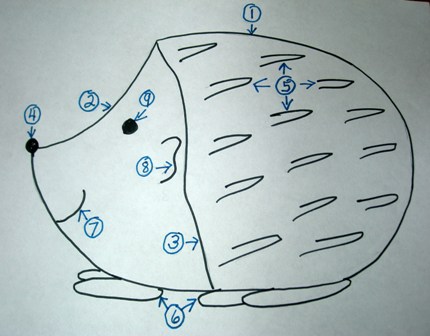
I've been filling in for a staff member on medical leave this summer. I am doing a storytime for ages 4 to 7. The themes had already been selected. This week's theme was hedgehogs which is one that I have never done. We hit the peak of activity in July and there has not been much time to work on programs lately so I had to come up with a bunch of hedgehog activities to go with the books that had also been previously selected. (I only used two of the books and filled in with other forms of storytelling.)

While I was on Jan Brett's website looking for ideas I came across the page "How to Draw a Hedgehog" which gave me an idea. The drawing was quite simple and could be used for a draw and tell story. All I had to do was make up the story which I did. It can be found as a Google document here. I now had my opening activity for the storytime. Thank you Jan Brett!

Drawing Sequence

Drawing done during storytime on
18" by 24" newsprint paper
(Apologies for the folds)

Amanda of Toddler Tales is hosting this week's Flannel Friday Round Up. Complete information about Flannel Friday can be found here.

Friday, March 9, 2012

Finger Puppets Or How I Do "Five Little Monkeys"

Lately I've been trying to come up with program ideas that tie in with the summer reading theme of Dream Big - Read!  I plan to do an evening pajama story time.  If I do stories about bedtime then I'll be doing "Five Little Monkeys Jumping on the Bed."  This will give me a chance to use my new "old favorite," the Monkey Mitt.  When I use the mitt the little monkeys get do a lot of bouncing up and down.

Early in my career as a children's librarian I came across the Monkey Mitt and its assorted pom pom puppets.  I went through three mitts in the fifteen years I was in my previous position (the mitts would lose their "furriness" from frequent use).  The puppets stood up surprisingly well over that same period with only a few glue repairs needed.  I had a core group of rhymes that I used over and over.  Children paid attention when I put on that big fuzzy mitt.

Since I don't regularly work with younger children, I haven't had much need to use a Monkey Mitt but recently I decided to get one "just in case."   I just might not wait until summer to use it.  After all I have a couple of two-year-olds who regularly come to Family Story Time.

Because I like to use multiple ways of presenting material in a single program, I usually have a finger puppet rhyme when I do a toddler or preschool program.  I particularly like to use finger puppets when doing counting rhymes.  Often children will hold up their own fingers and follow along.

Finger puppets can be made from felt and even knitted.  Many sets are commercially available, including some lovely animal ones from Folkmanis.  However, simple ones can be made using paper.  I have several paper sets with rhymes that I made years ago using the book, Mitt Magic by Lynda Roberts.  Before I started doing a craft at the end of a program, I would send the children home with an activity sheet that the child and caregiver could do together.  Often I would give out a sheet with the rhyme I had used that day with the finger puppets to color and make.  Paper finger puppets can easily be made to go with a rhyme.  They don't have to be fancy.  In fact simple is better for they need to be easily seen. 

"Two Little Blackbirds" is a rhyme that can be done with just fingers.  I always have the children participate since it is such a simple rhyme.  I like to point out that they will always have their "puppets" with them and can do the rhyme any time they want to do it.

Finger puppets make a great visual accompaniment to a story time rhyme.  The basic set is always available at no cost.  Other sets range from simple paper ones to beautifully designed figures and animals.  Because they take up little space they travel well.  My original Monkey Mitt sets traveled with me to numerous preschools and elementary schools throughout the years.

Finger puppets:
Purchased puppets have great details.

Semi-homemade puppets are quick and easy.
The bugs are felt stickers.
The giraffe was made from animal print felt.

Paper
The duck is from billybear4kids.com.
The kittens and dog are from a set I did years ago to go with a rhyme.
I have the dog turned over to show how they are made.
I show how to make paper finger puppets here.

Some day I will knit one of these:

Consider using finger puppets instead of the flannel board, especially when doing counting rhymes.   Not only does it add variety to a program but it's fun. 

(Busy librarian tip:  One thing I like about using finger puppets is that I can have a copy of the rhyme next to the puppets I am adding or removing so I can discretely look down to read the rhyme as I move the puppets - no memorization required.)

(Craft tip:  Children enjoy making finger puppets. Although the ones that sit on top of the finger are fun, children particularly enjoy the ones with the holes so their fingers can be part of the puppet.  Enchanted Learning has some examples.)

(Note:  I am hosting this week's Flannel Friday Round-Up which can be found here.)